A picture in your mind – and how it really was
What do you imagine when you hear ‘test activation of the high-pressure water mist fire protection system on a train’? A kind of summer rain in the train compartment like in a fantasy film? Perhaps similar to the AI-generated image?
The reality was somewhat more sobering, but all the more important for that: FOGTEC, together with the IFAB and the customer Stadler Bussnang AG, carried out a test in the latest vehicles at the Stadler factory in Erlen. The good news first: the test was successful and everything worked as intended. The supposedly bad news? It didn’t look nearly as spectacular as in the picture…
Real technology instead of Hollywood fire
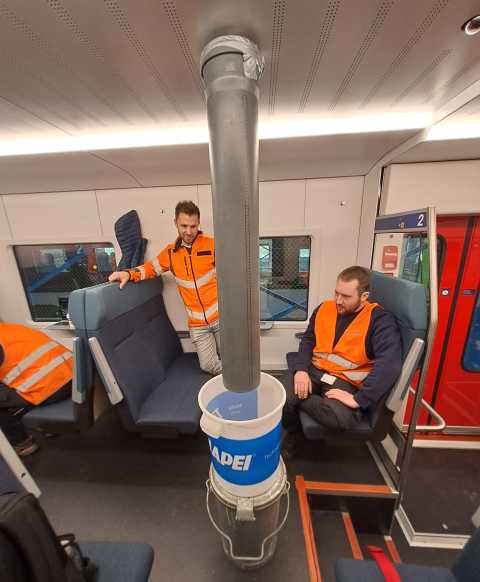
The test was prepared with precision: after planning on the computer, half a day was spent setting everything up on site. Then it was time to get started. Two smoke detectors (from the 5000 series) were triggered with test gas. These reported the supposed fire to the central FOGTEC control unit (CPU), which then activated the fire protection system.
The fire protection system typically consists of water and nitrogen cylinders mounted either under the train or, as in this case, on the roof in a carrier unit. The nitrogen generates the pressure required to transport the water through thin stainless steel pipes to the nozzles in the train compartments (carriage, toilets, driver’s cab, etc.).
The endurance test: pressure at the furthest point
The area furthest away from the pressure vessels in the train was specifically triggered. A few seconds after the detectors were activated, water mist sprayed from the nozzles. The aim was to check whether sufficient water would arrive at the furthest point of the system with adequate pressure within the specified transport time.
The test was completed after about ten minutes. As intended, the containers in the carrier unit were empty, and the test was over. The result: everything was fine. And no one got wet. Unlike in the AI image, the escaping water was collected so that pressure and volume could be measured accurately.
Efficiency instead of flooding
Even in an emergency, the interior remains dry – at least where there is no fire. This is one of the advantages of high-pressure water mist technology: a high extinguishing effect is achieved with comparatively little water. The system is only triggered in the area where a fire has actually been detected; the surrounding areas are not sprayed.
Additionally, the high-pressure mist can be activated in the passenger compartment without warning, and the doors do not need to be closed. The system acts quickly, localises the fire and creates safe zones for passengers and staff.
Why all the effort?
Trigger tests like this are often part of the approval process – for example, in projects that follow the Italian standard UNI 11565. This sets requirements for fire protection systems in rail vehicles, including function tests and performance tests.
UNI approval was not mandatory for this project. Nevertheless, Stadler Bussnang AG opted to conduct the test for safety reasons and due to the unique system design.